OEM vs ODM Apparel Manufacturing: Buyer Decision Guide
Compare OEM and ODM routes by brief maturity, buyer control, sampling inputs and approval responsibility.
Read procurement guide →Apparel sourcing knowledge
Practical, specification-led guidance for sourcing materials, heavyweight garments, wash processes, decoration and OEM/ODM production.
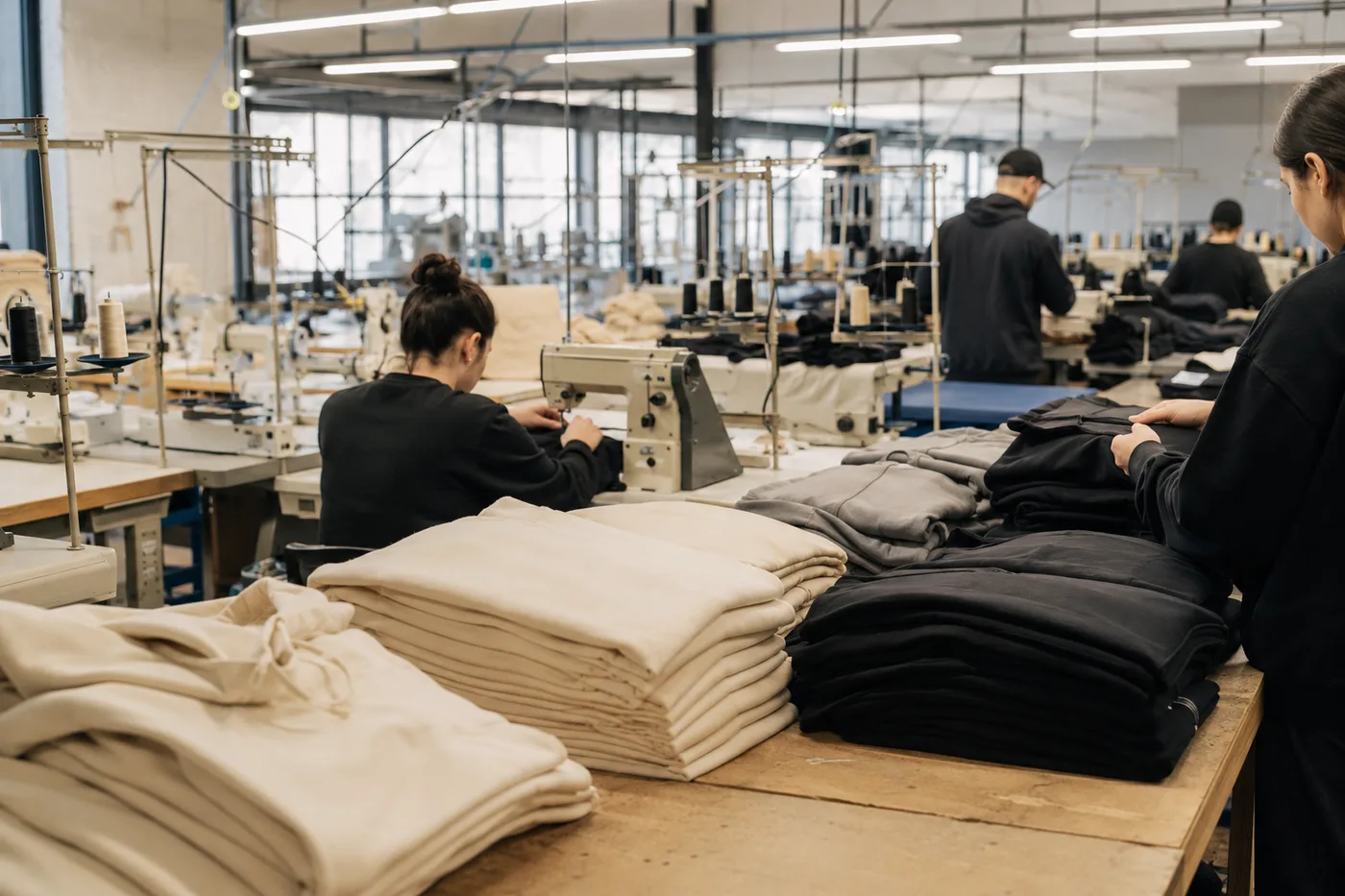
Compare OEM and ODM routes by brief maturity, buyer control, sampling inputs and approval responsibility.
Read procurement guide →Prepare artwork, placement, garment references, sample approval and bulk-release requirements for screen printing.
Read procurement guide →Specify embroidery size and position with measurable garment reference points and clear approval controls.
Read procurement guide →Translate an oversized design direction into measurable fit, material and bulk-order requirements.
Read procurement guide →Follow a buyer-led workflow from product brief and sample approval through allocation and bulk planning.
Read procurement guide →Review wash shade, surface, measurements, decoration and release decisions against approved references.
Read procurement guide →Prepare one controlled artwork package for printing or embroidery, including version, size, placement and sample approval.
Read procurement guide →Review material, measurements, wash, decoration, allocation and approval records before bulk production.
Read procurement guide →Build a color-by-size allocation matrix that reconciles every unit with the approved style quantity.
Read procurement guide →Create an RFQ-ready specification covering material, wash, fit, decoration, quantities and approval controls.
Read procurement guide →Define delivery measurement tolerances separately from dimensional change after laundering.
Read procurement guide →Set buyer-controlled colorfastness references, test requirements and approval decisions for garment-dyed T-shirts.
Read procurement guide →Compare loopback French terry and brushed fleece by construction, warmth, hand feel and intended hoodie use.
Read procurement guide →Define cuff and hem rib construction, measurements, recovery, attachment and sample approval for hoodie production.
Read procurement guide →Specify the test method, exposure, rating scale and acceptance threshold for traceable fabric and garment decisions.
Read procurement guide →Control label content, placement, artwork, materials, hangtags and approval records for private-label apparel.
Read procurement guide →Set measurable seam, stitch, reinforcement and workmanship requirements for heavyweight T-shirt production.
Read procurement guide →Define neckline rib material, dimensions, attachment, recovery and approval points for heavyweight T-shirts.
Read procurement guide →Specify garment packing, carton construction, shipping marks and reconciliation controls for export handover.
Read procurement guide →Country-of-origin compliance connects the physical garment label and packaging statement with a traceable fiber, manufacturing, and shipment document set. Weavnora supports 100% cotton heavyweight or washed T-shirts in 220–300 GSM plus related hoodies and casualwear, with a 1,000-piece style MOQ, about 7-day samples after details are confirmed, and about 30-day bulk timing project-dependent for NA/EU buyers; final legal wording should be confirmed for the destination.
Read procurement guide →Zipper pull-strength and slider QC verifies that the puller, slider, teeth or coil, stops, and sewn attachment withstand defined opening and closing forces. Weavnora applies the approval to related cotton hoodies and casualwear alongside 100% cotton heavyweight or washed T-shirts in 220–300 GSM, with a 1,000-piece style MOQ, about 7-day samples after details are confirmed, and about 30-day bulk timing project-dependent for NA/EU.
Read procurement guide →Print cure approval links the ink system, cure temperature, dwell time, and wash-after-print adhesion result before production. Weavnora supports screen print, DTG, embroidery, and special print on 100% cotton heavyweight or washed T-shirts in 220–300 GSM, with a 1,000-piece style MOQ, about 7-day samples after details are confirmed, and about 30-day bulk timing project-dependent for NA/EU.
Read procurement guide →Rib collar recovery QC measures how far a collar stretches and how well it returns after wear, pull, and wash. Weavnora applies the approval gate to 100% cotton heavyweight or washed T-shirts in 220–300 GSM, with related hoodies and casualwear, a 1,000-piece style MOQ, about 7 days for samples after details are confirmed, and about 30 days for bulk project-dependent for NA/EU buyers.
Read procurement guide →Seam-strength and stitch-type approval for washed heavyweight tee OEM is the buyer-controlled sequence that freezes stitch class, SPI, needle size, and seam pull/burst criteria before bulk. For Weavnora 100% cotton washed heavyweight T-shirt programs in the 220–300 GSM range, confirm construction on sample after details are locked (about 7-day sample window), then release the 1,000-piece style MOQ into an about 30-day bulk plan (project-dependent) for North America and Europe.
Read procurement guide →Embroidery artwork and backer approval before bulk apparel OEM is the buyer-controlled sequence that freezes the stitch file, thread colors, backer/stabilizer type, and sample placement before production. For Weavnora 100% cotton heavyweight or washed T-shirt programs in the 220–300 GSM range (and related hoodie/casualwear), confirm embroidery PPS after details are locked (about 7-day sample window), then release the 1,000-piece style MOQ into an about 30-day bulk plan (project-dependent) for North America and Europe.
Read procurement guide →Button and snap pull-strength QC for apparel export OEM is the buyer-controlled sequence that freezes attachment method, pull-force targets, and fail/rework rules before cartons leave the factory. For Weavnora 100% cotton heavyweight or washed T-shirt programs in the 220–300 GSM range (and related hoodie/casualwear with hardware), confirm pull-strength after details are locked (about 7-day sample window), then release the 1,000-piece style MOQ into an about 30-day bulk plan (project-dependent) for North America and Europe.
Read procurement guide →Dye-lot continuity and shade banding control for garment-dyed cotton tee OEM is the buyer-controlled sequence that freezes dye-lot IDs, shade-band tolerances, and cross-lot mixing rules before bulk packing. For Weavnora 100% cotton heavyweight or washed T-shirt programs in the 220–300 GSM range, confirm shade continuity after details are locked (about 7-day sample window), then release the 1,000-piece style MOQ into an about 30-day bulk plan (project-dependent) for North America and Europe.
Read procurement guide →Polybag moisture and mold-risk packing controls for ocean-freight apparel OEM are the buyer-controlled rules that freeze polybag type, moisture limits, desiccant use, and carton lining before containers sail. For Weavnora 100% cotton heavyweight or washed T-shirt programs in the 220–300 GSM range, confirm packing acceptance after details are locked (about 7-day sample window), then release the 1,000-piece style MOQ into an about 30-day bulk plan (project-dependent) for North America and Europe. Unlike air-freight short hauls, ocean-freight programs need stronger moisture and mold-risk controls because transit time and humidity swings are longer.
Read procurement guide →Hangtag and brand-label approval before bulk apparel OEM is the buyer-controlled sequence that freezes hangtag artwork, brand-label copy, placement, and care/fiber wording before cartons ship. For Weavnora 100% cotton heavyweight or washed T-shirt programs in the 220–300 GSM range, confirm label pack acceptance after details are locked (about 7-day sample window), then release the 1,000-piece style MOQ into an about 30-day bulk plan (project-dependent) for North America and Europe. Unlike late carton stickers, hangtag and brand-label approval should finish before bulk sewing so trims match the approved tech pack.
Read procurement guide →A shrinkage test protocol for washed heavyweight cotton tee OEM is the buyer-controlled sequence that freezes wash method, measurement points, and acceptable length/width change before bulk release. For Weavnora 100% cotton washed or heavyweight T-shirt programs in the 220–300 GSM range, confirm shrinkage acceptance after details are locked (about 7-day sample window), then release the 1,000-piece style MOQ into an about 30-day bulk plan (project-dependent) for North America and Europe. Unlike greige-only checks, washed-program shrinkage tests judge dimensional change after the commercial wash state that will ship.
Read procurement guide →Needle detection and metal contamination QC for apparel export OEM is the buyer-controlled sequence that freezes detector sensitivity, broken-needle logging, and re-pass rules before cartons leave the factory. For Weavnora 100% cotton heavyweight or washed T-shirt programs in the 220–300 GSM range, confirm metal-free release after details are locked (about 7-day sample window), then release the 1,000-piece style MOQ into an about 30-day bulk plan (project-dependent) for North America and Europe.
Read procurement guide →A sample-to-bulk lead-time planning calendar for apparel OEM is the buyer-controlled timeline that sequences detail lock, ~7-day sample, approvals, and ~30-day bulk against a 1,000-piece style MOQ. For Weavnora 100% cotton heavyweight or washed T-shirt programs in the 220–300 GSM range, freeze the calendar after details are confirmed, then release North America and Europe shipments on the agreed project-dependent dates.
Read procurement guide →Care-label and fiber-content compliance for apparel OEM export to NA/EU is the buyer-controlled labeling package that freezes fiber claim, care instructions, and country-of-origin wording before bulk sewing. For Weavnora 100% cotton heavyweight or washed T-shirt programs in the 220–300 GSM range, approve labels after details are confirmed (about 7-day sample window), then release the 1,000-piece style MOQ into an about 30-day bulk plan (project-dependent) for North America and Europe.
Read procurement guide →Size-spec measurement tolerance for washed or heavyweight tee OEM is the buyer-controlled POM table that freezes measurement points and after-wash tolerances before bulk cutting. For Weavnora 100% cotton heavyweight or washed T-shirt programs in the 220–300 GSM range, approve the size spec after details are confirmed (about 7-day sample window), then release the 1,000-piece style MOQ into an about 30-day bulk plan (project-dependent) for North America and Europe. This size spec measurement tolerance is the signed rule used to grade washed bulk tees after the approved sample.
Read procurement guide →A colorfastness wash-test protocol for cotton tee OEM is the buyer-controlled sequence that freezes wash method, cycle count, and acceptable shade/staining change before bulk release. For Weavnora 100% cotton heavyweight or washed T-shirt programs in the 220–300 GSM range, confirm wash-test acceptance after details are locked (about 7-day sample window), then release the 1,000-piece style MOQ into an about 30-day bulk plan (project-dependent) for North America and Europe.
Read procurement guide →An apparel packing list checklist for OEM export orders is the buyer-controlled document that lists style, color, size, carton counts, and piece quantities so shipment contents match the commercial invoice and warehouse ASN. For Weavnora 100% cotton heavyweight or washed T-shirt programs in the 220–300 GSM range, lock the packing list with packing rules after sample confirmation (about 7 days), then apply it on cartons supporting the 1,000-piece style MOQ and about 30-day bulk plan (project-dependent) for North America and Europe.
Read procurement guide →Washed tee GSM handfeel approval is the buyer-controlled check that freezes fabric weight and hand on production-intent washed cotton before bulk. For Weavnora 100% cotton heavyweight or washed T-shirt programs in the 220–300 GSM range, approve GSM and handfeel after details are confirmed (about 7-day sample window), then release the 1,000-piece style MOQ into an about 30-day bulk plan (project-dependent) for North America and Europe.
Read procurement guide →Washed tee GSM handfeel approval is the buyer-controlled check that freezes fabric weight and hand on production-intent washed cotton before bulk. For Weavnora 100% cotton heavyweight or washed T-shirt programs in the 220–300 GSM range, approve GSM and handfeel after details are confirmed (about 7-day sample window), then release the 1,000-piece style MOQ into an about 30-day bulk plan (project-dependent) for North America and Europe.
Read procurement guide →A carton mark specification for apparel export OEM orders is the buyer-controlled set of exterior carton texts, barcodes, and icons that identify PO, style, color, size break, quantity, and destination before shipment. For Weavnora 100% cotton heavyweight or washed T-shirt programs in the 220–300 GSM range, lock carton marks with packing and polybag rules after sample confirmation (about 7 days), then apply them on cartons supporting the 1,000-piece style MOQ and about 30-day bulk plan (project-dependent) for North America and Europe.
Read procurement guide →A lab dip approval workflow for garment-dyed tee OEM is the buyer-controlled sequence that freezes shade, wash state, and fabric hand before bulk dyeing. For Weavnora 100% cotton heavyweight or washed T-shirt programs in the 220–300 GSM range, approve lab dips after details are confirmed (about 7-day sample window), then release the 1,000-piece style MOQ into a about 30-day bulk plan (project-dependent) for North America and Europe.
Read procurement guide →An apparel strike-off approval workflow is the buyer-controlled sequence that freezes print color, coverage, and placement on a production-representative garment before bulk cutting. For Weavnora 100% cotton heavyweight or washed T-shirt programs in the 220–300 GSM range, approve the strike-off on the agreed fabric and wash state after confirmation (~7-day sample window), then release the 1,000-piece style MOQ into a ~30-day bulk plan (project-dependent) for North America and Europe.
Read procurement guide →An apparel final inspection checklist for T-shirt OEM is the buyer’s pre-shipment release gate covering measurements, workmanship, decoration, labeling, packing, and sampling plan. For Weavnora 100% cotton heavyweight or washed T-shirt programs in the 220–300 GSM range, inspect against the approved sample and tech pack after bulk (about 30 days project-dependent from approvals), inside a 1,000-piece style MOQ with mixed colors and sizes, before NA or EU handover.
Read procurement guide →A hoodie quote depends on more than GSM. A buyer should specify French terry or brushed fleece, target weight, fiber and yarn, fit, wash, decoration, trims, quantity, destination and sample plan. Weavnora replies within 1 business day when the brief is clear.
Read procurement guide →A quote-ready washed T-shirt brief should state the silhouette, size range, 220–300 GSM target, cotton or fiber, wash effect, color references, artwork, quantity, packaging, destination and sample plan. Weavnora replies within 1 business day when these inputs are clear.
Read procurement guide →A private label t-shirt first order usually moves from RFQ and sample to approval, bulk production and inspection. Send quantity, 220–300 GSM target, fabric, wash, artwork, labels, packaging, NA/EU destination and deadline. Bulk MOQ is 1000, samples are allowed, and Weavnora aims to reply within 1 business day at postmaster@weavnora.com.
Read procurement guide →Send a complete washed t-shirt OEM RFQ with target quantity, 220–300 GSM, fabric, wash, colors, size ratio, artwork, labels, packaging, destination and deadline. Weavnora can reply within 1 business day; MOQ for bulk is 1000 pieces, and samples are allowed.For a fast washed t-shirt OEM quote, send quantity, GSM, fabric, wash effect, color and size breakdown, artwork, private-label trims, packaging, destination and target date. Bulk MOQ is 1000 pieces; sample requests are welcome. Email postmaster@weavnora.com for a reply within 1 business day.
Read procurement guide →An apparel bulk production booking window is the controlled period after sample approval when a buyer confirms the 220–300 GSM specification, 1,000-piece MOQ, destination and purchase order. Weavnora typically allows about 7 days for a sample and roughly 30 days for bulk production for North America and Europe.
Read procurement guide →An apparel lab dip approval timeline is a staged color-release plan: freeze the 220–300 GSM cotton target, review a lab dip in about 7 days, document the decision, and release a 1,000-piece minimum order for roughly 30-day bulk production. Weavnora supports buyers in North America and Europe.
Read procurement guide →An apparel measurement tolerance sheet lists each point of measure, the reference size, measurement method, wash state and acceptable limits. For Weavnora, freeze the chart on a 220–300 GSM 100% cotton T-shirt before bulk. The program uses a 1,000-piece MOQ, about 7-day samples and about 30-day bulk timing for North America and Europe.
Read procurement guide →A T-shirt color approval workflow is a documented sequence that moves a buyer from a target shade and lab dip to an approved production standard. For Weavnora programs, record the reference, fabric, wash, lighting, tolerances and signed approval before bulk cutting. Weavnora supplies 220–300 GSM 100% cotton garments with a 1,000-piece MOQ, about 7-day samples and about 30-day bulk timing for North America and Europe.
Read procurement guide →A pre-production sample (PPS) is the buyer-approved production-representative garment that freezes fabric, construction, measurements, labels, decoration, and packing before bulk cutting. For Weavnora 100% cotton heavyweight or washed T-shirt programs in the 220-300 GSM range—and related hoodie/casualwear—approve the PPS after details are confirmed (~7-day sample window), against a 1,000-piece style MOQ, so the later ~30-day bulk plan for NA and EU shipments matches what was signed off.
Read procurement guide →Ring-spun yarn is continuous-fiber spun yarn with a smoother, stronger hand; open-end (OE/rotor) yarn is shorter-fiber spun yarn with a more textured, economical hand. For Weavnora 100% cotton heavyweight or washed T-shirts in the 220-300 GSM window, buyers should name the yarn system in the tech pack, then confirm it on a production-representative sample (~7 days after confirmation) against a 1,000-piece style MOQ before the ~30-day bulk plan for NA and EU programs.
Read procurement guide →An apparel polybag specification should define garment folding, bag dimensions, suffocation warning, size sticker, assortment, carton count and final packing inspection before export. This control ties the approved packaging sample to the purchase order, carton packing list and final shipment release so that size, color, warning and quantity can be checked consistently.
Read procurement guide →An apparel metal contamination control plan should define broken-needle accountability, needle detector sensitivity, test pieces, records and final inspection before a 1,000-piece shipment of 220–300 GSM cot The documented process combines needle detector apparel QC with broken-needle logs, garment inspection, corrective action and final shipment release.ton garments.
Read procurement guide →A DTG artwork handoff for a washed T-shirt should define the print size and position, transparent background, artwork color intent, garment color, file version and approved sample. Send production-ready artwork with the 220–300 GSM garment brief before a 1,000-piece MOQ release.
Read procurement guide →For a 220–300 GSM cotton heavyweight T-shirt, choose a rib neckband when controlled stretch and recovery are central to the neckline; choose a self-fabric collar when a cleaner body-fabric visual is the priority. Confirm the decision on a finished sample before a 1,000-piece MOQ bulk order.
Read procurement guide →Hoodie fleece GSM is the fabric weight per square metre and should be selected with fiber, knit structure, brushing, fit, and wash route—not alone. For Weavnora, freeze the hoodie fleece brief and decoration on sample, while 100% cotton tee programs commonly target 220–300 GSM; confirm the sample in about 7 days after confirmation and plan the 1,000-piece style MOQ into an approximately 30-day bulk window (project-dependent) for NA/EU buyers.
Read procurement guide →A washed t-shirt inspection AQL plan classifies critical, major, and minor defects, defines the sample size and acceptance rule, and checks measurements, shade, wash character, stitching, decoration, labels, and packing before bulk release. For Weavnora, align the plan to 100% cotton at 220–300 GSM, confirm the sample in about 7 days, and release the 1,000-piece style MOQ only after approval for an approximately 30-day bulk window in NA/EU programs.
Read procurement guide →Acid wash and enzyme wash are two finish routes for heavyweight cotton tee programs. Acid wash is usually chosen for a stronger, more distressed visual; enzyme wash is often chosen for a softer, more controlled broken-in handfeel with milder contrast. For Weavnora OEM on 100% cotton tees at 220–300 GSM, freeze the wash route before the ~7-day sample after confirmation, keep decoration approved on the washed base, and plan the 1,000-piece style MOQ into a ~30-day bulk window (project-dependent) for NA and EU.
Read procurement guide →Tubular and side-seam are two body constructions for heavyweight cotton tee OEM. Tubular knits the body as a tube with no side seams; side-seam panels are cut and sewn at the sides for cleaner shaping and easier decoration placement. For Weavnora programs on 100% cotton tees at 220–300 GSM, freeze construction before the ~7-day sample after confirmation, approve decoration on that body, then plan the 1,000-piece style MOQ into a ~30-day bulk window (project-dependent) for North America and Europe.
Read procurement guide →Special print on heavyweight cotton T-shirts is a decoration path beyond standard single-process screen print or DTG—used when a buyer needs elevated texture, effect inks, or process combinations on a 100% cotton base in the 220-300 GSM range. Lock the effect, artwork limits, and wash checks before the ~7-day sample after confirmation, then plan the 1,000-piece style MOQ and ~30-day bulk window (project-dependent) against the approved printed sample.
Read procurement guide →Apparel sample lead time at Weavnora is about 7 days after confirmation for a production-representative sample of 100% cotton heavyweight or washed T-shirts in the 220–300 GSM range. Confirmation means fabric target, construction, wash or finish direction, decoration method, and size/color intent are locked so the sample can protect a later ~30-day bulk plan (project-dependent) inside a 1,000-piece style MOQ with mixed colors and sizes.
Read procurement guide →An apparel MOQ assortment is the buyers planned mix of colors and sizes inside a style minimum—here 1,000 pieces per style—so the factory can cut, sew, decorate, and pack without rework. For 100% cotton heavyweight T-shirts at 220–300 GSM, freeze shade standards and the size curve before the ~7-day sample after confirmation, then release a ~30-day bulk plan (project-dependent) against the approved mix.
Read procurement guide →Embroidery on a heavyweight cotton T-shirt is stitched thread decoration applied to a buyer-selected 100% cotton base in the 220–300 GSM range. Lock placement, size, stitch density, and thread before sampling so the ~7-day sample after confirmation matches bulk, then plan color/size mix inside the 1,000-piece style MOQ for a ~30-day bulk run (project-dependent).
Read procurement guide →DTG and screen print are two decoration paths for 100% cotton heavyweight T-shirts in the 220-300 GSM range. Screen print usually fits larger, stable artwork runs; DTG often fits multi-color or shorter creative cycles. For Weavnora OEM programs, choose the method before sampling, keep the 1,000-piece style MOQ and color/size mix clear, and approve decoration on a production-representative sample (~7 days after confirmation) before the ~30-day bulk plan.
Read procurement guide →A heavyweight T-shirt GSM target is the buyer-selected fabric weight, usually inside 220-300 GSM for 100% cotton programs, that defines handfeel, drape, and wash behavior before sample and bulk. Lock GSM with construction, finish, decoration method, and a 1,000-piece style MOQ so the ~7-day sample after confirmation represents the commercial garment and protects the later ~30-day bulk plan.
Read procurement guide →A tech pack for heavyweight T-shirt OEM is the single buyer document that names the garment, fabric, construction, measurements, dye or wash direction, decoration, labeling, and quality gates before a factory builds a production-representative sample. For 100% cotton programs at 220–300 GSM with a 1,000-piece style MOQ, a complete pack makes the ~7-day sample after confirmation meaningful and protects the later ~30-day bulk plan.
Read procurement guide →Garment dye means the finished or nearly finished T-shirt is dyed after cut-and-sew, so color develops on the complete garment. Piece dye means the fabric is dyed before cutting, so panels arrive already colored. For 100% cotton heavyweight tees at 220–300 GSM, pick piece dye for tighter shade continuity across sizes and cartons, and garment dye when you want a lived-in color character and softer broken-in handfeel.
Read procurement guide →